



From Discovery to Impact: A New Strategic Plan for NIH HIV Research
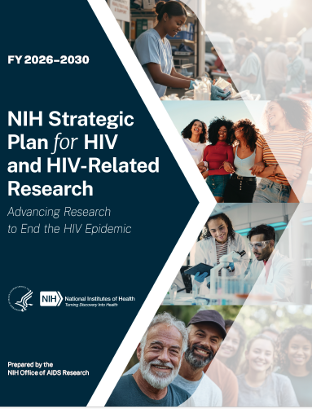
I am delighted to share the FY 2026–2030 NIH Strategic Plan for HIV and HIV-Related Research, the first NIH HIV research strategic plan developed during my tenure as Director of the Office of AIDS Research. The Plan reflects the contributions of scientific staff across NIH; members of the broader HIV community; and external experts, including researchers and health care providers. I am deeply grateful to everyone who helped us reach this important milestone.
The Plan introduces a new framework for NIH HIV research, organized around three strategic goals: advancing HIV science across the research-to-practice continuum, strengthening the capacity and infrastructure needed to support that research, and managing the NIH HIV research investment efficiently and effectively. Importantly, these goals are guided by foundational principles—comprehensive, multidisciplinary research; population-focused health; and multisectoral partnerships—that reflect the breadth of science, people, and partnerships needed to address the evolving HIV epidemic.
One aspect of the new framework is particularly meaningful to me: accelerating implementation science to end the HIV epidemic as an overarching priority for NIH HIV research. As founder and former Director of the Center for Dissemination and Implementation Science at the University of Illinois Chicago, I have long championed the potential of implementation science to get effective interventions into communities faster to fully realize their public health impact. Indeed, we have learned that knowing whether an intervention works is only part of the scientific challenge. We also need rigorous research to understand how, where, and under what conditions effective interventions can be successfully adopted, delivered, and sustained in real-world settings. The Plan encourages us to apply an implementation lens early in the research process so that real-world use is considered as interventions are designed, developed, and evaluated. I am excited to see an expansion of the field in the NIH HIV research portfolio.
At the same time, elevating implementation science does not lessen NIH’s commitment to the full spectrum of HIV research as outlined in the new Plan. Fundamental discovery remains essential to understanding HIV and identifying new scientific opportunities; preclinical research transforms those discoveries into promising tools and approaches; intervention research rigorously evaluates prevention, treatment, cure, and service strategies; and implementation research indicates how best to deliver proven interventions in the real world. Together, these stages form the research-to-practice continuum at the heart of the new Plan. By strengthening the connections across the continuum, we can continue pursuing the discoveries of tomorrow while making the most of the scientific advances we have today.
I am eager to see where this Plan will take us over the next 5 years, and I am grateful to the researchers, communities, and partners who will bring it to life. Our challenge now is to continue to push the boundaries of HIV science while strengthening the bridge between discovery and delivery. This bridge is how we will turn the extraordinary promise of HIV research into lasting impact for people with and affected by HIV—and move closer to ending the HIV epidemic.
This page last reviewed on September 30, 2026